AI has moved beyond answering questions and generating content. Businesses are increasingly exploring AI systems that can understand instructions, retrieve information, use tools, and complete multi-step tasks.
These systems, commonly known as AI agents, are changing how organizations approach business automation, customer support, sales operations, and software development.
Unlike traditional automation tools that follow predefined rules, AI agents can interpret requests, gather relevant information, and determine appropriate actions within defined permissions. They can also connect with existing business applications to support everyday workflows.
In this guide, we explore what AI agents are, how they work, their business applications, key benefits, and important considerations before implementing them.
1. What Are AI Agents?
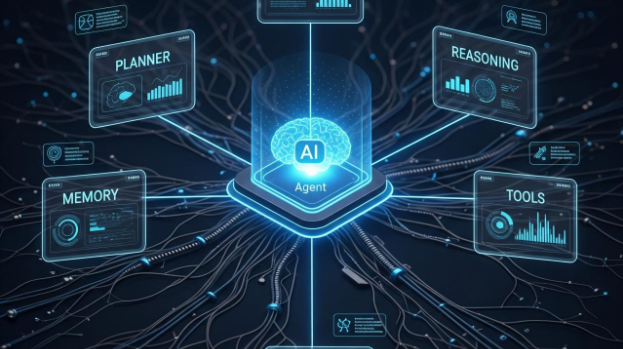
AI agents are software systems that use artificial intelligence to achieve defined goals. Depending on their design, they can interpret instructions, gather information, plan actions, interact with external tools, and evaluate whether a task is complete.
The key difference between a traditional chatbot and an AI agent is its ability to move beyond providing information and perform actions within an approved environment.
For example, a chatbot might explain how to schedule a meeting. An AI agent could check calendar availability, identify a suitable time, prepare an invitation, and request approval before sending it.
Similarly, a business AI agent could retrieve customer information from a CRM, summarize previous interactions, and prepare a follow-up task for a sales representative.
Not every AI agent operates independently. Important or sensitive actions can require human approval to maintain control and reliability.
2. How Do AI Agents Work?
A typical AI agent follows five important stages:
Step 1: Understand the Objective
The system receives an instruction, identifies the expected outcome, and determines what information or actions it may need.
For example, a sales team might ask an AI agent to identify potential leads matching a specific customer profile.
Step 2: Gather Relevant Information
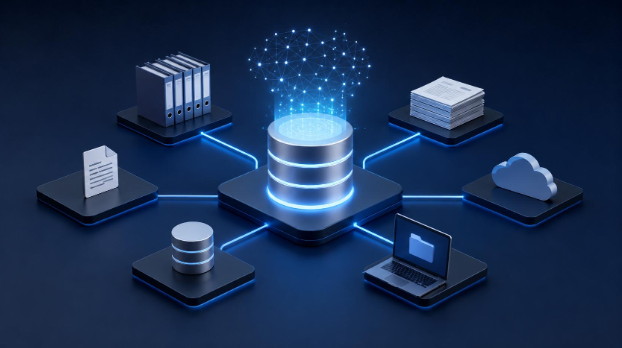
The agent retrieves information from authorized sources such as CRM platforms, internal knowledge bases, business databases or connected applications.
Access controls ensure the agent retrieves only the information it is permitted to use.
Step 3: Plan the Next Steps
Based on the request and available information, the agent determines an appropriate sequence of actions.
For example, it might check company details, review customer requirements, evaluate potential matches, and prepare a summary.
Step 4: Use Tools and Execute Actions
Through approved APIs and integrations, an AI agent can create records, update information, generate reports, or prepare communications according to its permissions.
Step 5: Validate the Result
The system checks whether the intended action succeeded and determines whether additional steps are required.
Reliable implementations also account for failed integrations, unclear instructions, and situations that require human intervention.
3. Five Business Applications of AI Agents
AI agents can support different departments by handling information-intensive and repetitive workflows.
1. Customer Support Automation
AI agents can retrieve support information, classify customer requests, summarize interaction history, and assist with routine inquiries.
For example, an AI support agent can retrieve relevant product information, identify a customer's issue and prepare an appropriate response. Complex or sensitive cases can be transferred to a human representative.
2. Sales and Lead Management
AI agents can help sales teams enrich permitted lead records, summarize prospect information, prioritize follow-ups, and prepare personalized outreach for human review.
This can reduce manual research and help sales representatives focus on qualified opportunities.
3. Administrative Operations
Businesses can use AI agents to extract invoice details, organize documents, check records, and prepare routine reports.
For example, an agent can collect information from approved invoice documents and prepare structured records for review. Financial approvals and sensitive transactions should retain appropriate human controls.
4. Software Development
AI agents can support software engineering workflows by analyzing codebases, generating tests, investigating errors, and documenting functionality.
They can assist development teams with repetitive engineering tasks, while human review and automated testing remain essential for code quality and security.
5. E-commerce and Business Operations
AI agents can connect with existing e-commerce and operations systems to assist with order inquiries, product information, inventory analysis, and exception handling.
4. Key Benefits of AI Agents for Businesses
When implemented around clearly defined workflows, AI agents can offer several practical benefits.
- Reduced repetitive work: Agents can handle suitable routine tasks, allowing employees to focus on more complex responsibilities.
- Improved productivity: Connected applications can support information gathering, record preparation, and multi-step workflows.
- Better information access: Agents can retrieve relevant information from authorized business systems.
- Consistent workflows: Defined instructions and validation steps help standardize routine processes.
- Flexible automation: Agents can interpret varied requests and work with different information sources.
- Improved customer experiences: AI-powered support workflows can help customers access relevant information more efficiently.
The actual benefits depend on workflow design, integration quality, permissions, and ongoing monitoring.
5. AI Agents vs. Traditional Automation
Traditional automation works well when a process follows predictable rules. AI agents are useful when tasks involve interpreting language, retrieving varied information, or choosing between possible actions.
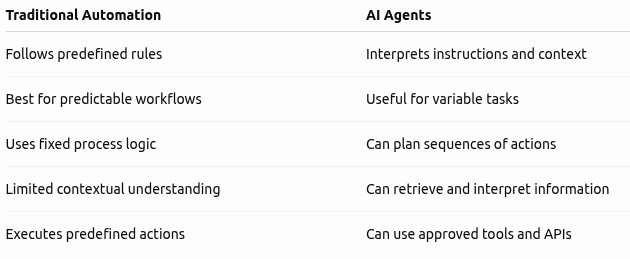
These approaches are not necessarily alternatives. Many effective business systems combine deterministic code for critical rules with AI for language understanding, information retrieval and flexible decision support.
6. What to Consider Before Implementing AI Agents
Building an AI agent requires more than connecting a language model to business software. Businesses should consider the following factors:
- Clear objectives: Define the task, expected outcome, and measurable business value.
- Limited permissions: Give agents access only to the tools and information they need.
- Human approval: Require authorization for sensitive, high-impact, or irreversible actions.
- Reliable integrations: Validate API responses, data formats, and transaction outcomes.
- Testing and monitoring: Evaluate realistic scenarios, errors and unexpected instructions.
- Cost management: Monitor model usage, execution time, and infrastructure expenses.
Starting with one well-defined workflow is usually more practical than attempting to automate an entire department immediately.
Frequently Asked Questions About AI Agents
What is the difference between AI agents and chatbots?
Traditional chatbots primarily provide information through conversations. AI agents can also retrieve information, use connected tools, and perform approved actions to complete defined tasks.
How can AI agents help businesses?
AI agents can support customer service, sales operations, administrative workflows, software development, and e-commerce operations.
Are AI agents fully autonomous?
Not necessarily. Their autonomy depends on their design. Businesses can define permissions, approval requirements, and human intervention points for important actions.
Can AI agents integrate with existing business software?
Yes. AI agents can connect to authorized CRM platforms, databases, calendars, e-commerce systems, and other applications through APIs and integrations.
What is the difference between AI agents and Agentic AI?
AI agents are individual software systems designed to perform tasks toward defined goals. Agentic AI describes a broader approach in which AI systems demonstrate goal-oriented behavior, planning, and tool usage with varying levels of autonomy.
How do businesses start implementing AI agents?
Businesses should identify a specific workflow, define the expected outcome, select suitable AI technology, connect approved applications, establish permissions and test the solution before wider deployment.
Conclusion: Build Smarter Business Workflows With AI Agents
AI agents are creating new opportunities for businesses to improve productivity, streamline operations and connect existing software systems through intelligent workflows.
From customer support and sales management to administrative operations and software development, their value comes from solving specific business problems rather than simply introducing another AI tool.
However, successful implementation requires clear objectives, reliable integrations, appropriate permissions, continuous monitoring, and human oversight.
Ready to explore AI agents for your business? Connect with Vision Vivante. We help businesses explore and develop AI agents, intelligent workflows, API integrations, and custom software solutions tailored to their operational requirements.